
It depends on where you and the other participant are located. The main legal question is usually what level of consent is required before recording.
Two Main Consent Models
- One-party consent - Recording is legal if at least one participant knows and agrees.
- All-party consent - Every participant must be informed and give consent.
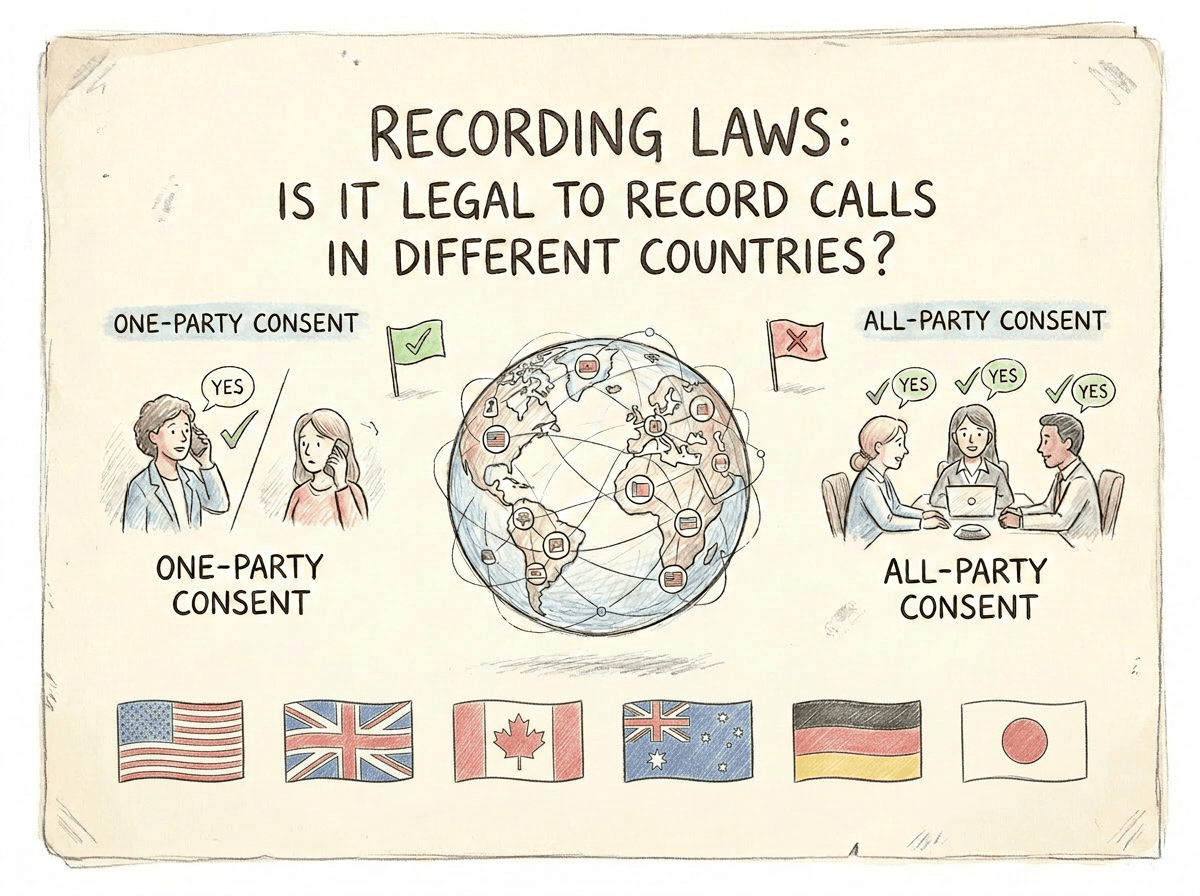
Country Overview
United States
- Federal law - Generally follows one-party consent under ECPA.
- State law - 11 states require all-party consent, including California, Florida, Illinois, Maryland, Massachusetts, Michigan, Montana, New Hampshire, Oregon, Pennsylvania, and Washington.
Europe
- Germany - Recording without prior notice is generally unlawful; explicit consent from all parties is required.
- United Kingdom - Personal recording may be allowed in limited scenarios, but sharing or publishing usually requires consent.
- Finland and Denmark - Personal recording between participants can be allowed, but disclosure without consent is restricted.
- Romania - Personal recording may be lawful, while publication and distribution remain restricted.
Other Countries
- Canada - Federal one-party consent model, with possible additional provincial requirements.
- New Zealand - Generally treated as all-party consent in practice.
- Russia - A participant may record their own conversation, but third-party interception without consent is prohibited.
Important Considerations
- Personal use vs publication - Recording for personal use may be legal while distribution requires additional consent.
- Business calls - Businesses often have stricter duties to notify participants at the start of calls.
- International calls - The safest approach is to follow the strictest applicable rule across all involved jurisdictions.
Practical Recommendations
- Always inform participants before recording.
- Obtain explicit consent where required.
- Check local law before recording any call.
- For business use, implement a clear call recording policy.
- For cross-border calls, apply the strictest rule.
Laws in this area change over time. For important legal decisions, verify current rules in the relevant jurisdiction or consult a qualified legal professional.